
From Rescuing to Encouragement: The Roles of Coaching, Mentorship, and Support in Burnout Recovery
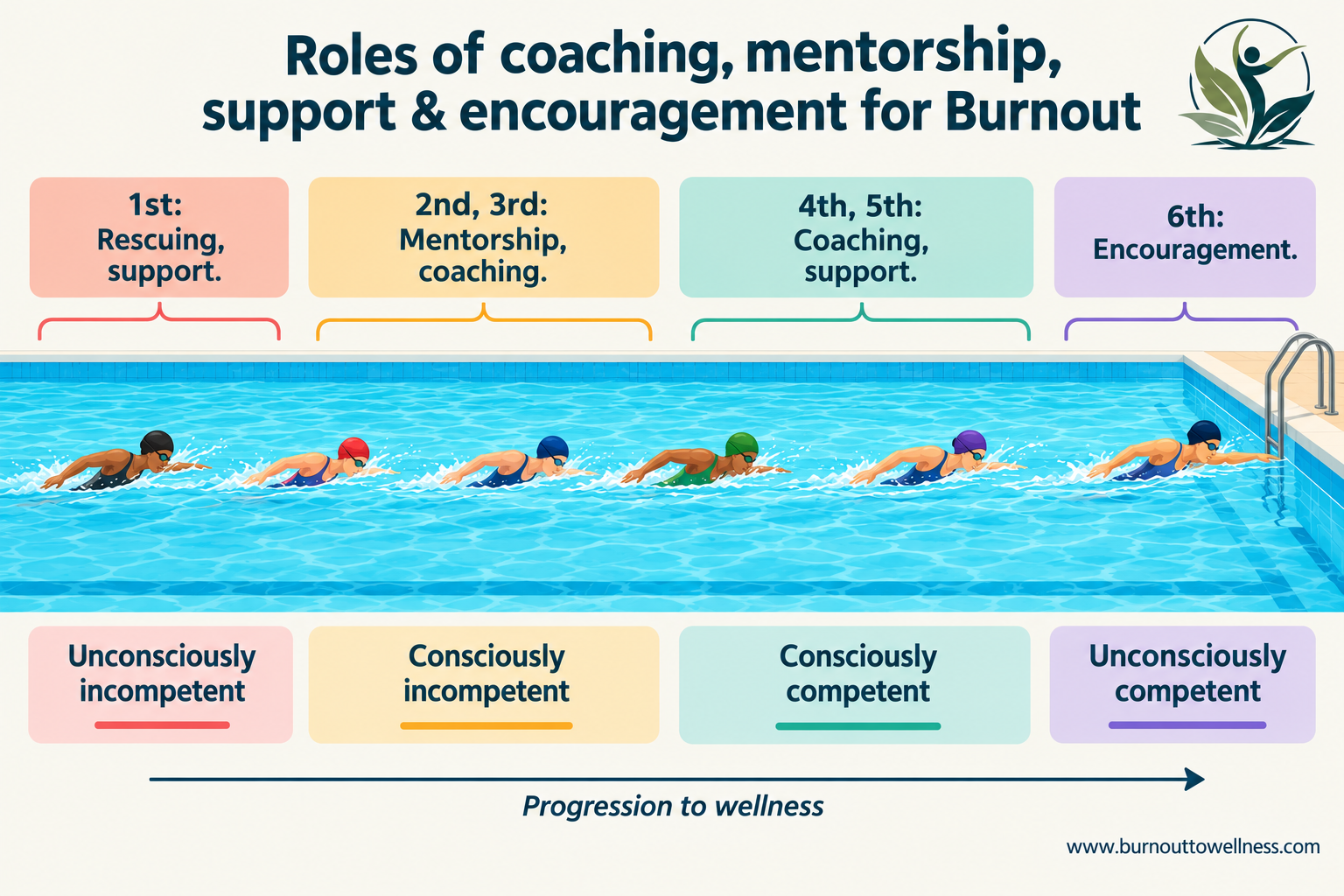
Burnout recovery is not a one-size-fits-all journey. When someone is experiencing burnout, the type of help they need depends on where they are in their journey, how much capacity they have to make changes, and how confident they feel about managing their circumstances.
Sometimes, people need someone to step in and help them regain stability. At other times, they need guidance, opportunities to practice new skills, or simply encouragement to continue moving forward.
Understanding the difference between rescuing, support, mentorship, coaching, and encouragement can help us become more effective in supporting colleagues, friends, family members, and ourselves through burnout.
The swimming pool analogy: Understanding the journey
Imagine six people swimming across a pool. Each person represents someone at a different point in their journey toward wellness. Although they are all moving in the same direction, they have different levels of awareness, skills, and confidence.
Some swimmers are struggling to recognize that they need help. Others understand their difficulties but are unsure how to overcome them. Some are learning and practicing new strategies, while others have developed healthy habits that they can maintain with little conscious effort.
The central message is simple: the support that helps one person may not be what another person needs.
To understand why, let’s explore the four stages of competence and how they relate to burnout recovery.
Stage 1: Unconsciously incompetent- When a person does not recognize the problem
At this stage, a person may not fully recognize that their current behaviors, workload, or coping strategies are contributing to their difficulties.
Consider a physician who routinely skips meals, works late into the night, sacrifices sleep to complete documentation, and feels guilty taking time off. They may believe that this is simply what being a dedicated physician requires. They might attribute their exhaustion, irritability, or declining concentration entirely to the demands of the profession.
The problem is not necessarily a lack of motivation. The person may not yet recognize the connection between their habits, working environment, and well-being.
What kind of help is needed?
Immediate support, and sometimes rescuing, may be appropriate.
When someone is severely overwhelmed, telling them to practice mindfulness, exercise regularly, or improve their work-life balance may be unrealistic. They may first need practical assistance, relief from excessive demands, or help accessing professional care.
For example:
A colleague takes over an urgent task so an exhausted physician can rest.
A supervisor helps prioritize an overwhelming workload and identifies tasks that can be deferred.
A friend listens without judgment and helps the person recognize that their current situation may not be sustainable.
A healthcare professional evaluates concerning symptoms when medical or mental health support is needed.
Rescuing, in this context, means intervening to address an immediate need or prevent further harm. It should not mean taking over someone’s life indefinitely or assuming they cannot make decisions for themselves.
The goal is to restore enough stability for the person to begin recognizing their situation and participating in their recovery.
Stage 2: Consciously incompetent - Recognizing the problem but not knowing how to solve it
This stage begins when people recognize that something needs to change but do not yet know how to make that change happen.
A physician may realize that working 60–70 hours a week, sleeping poorly, and neglecting relationships is affecting their health. They may understand that boundaries are important but feel uncomfortable saying no to additional responsibilities. They may want to exercise but struggle to find time, or they may know that they need rest but feel guilty when they are not working.
This stage can be emotionally difficult. Awareness often comes before confidence or the skills needed to change.
What kind of help is needed?
Mentorship, coaching, and practical support can help bridge the gap between awareness and action.
Mentorship can be particularly valuable when the person needs advice from someone with relevant experience. A senior physician might explain how they negotiated clinical responsibilities, managed competing priorities, or approached a difficult conversation with leadership.
Coaching offers a different kind of help. Rather than primarily providing answers, a coach helps the person clarify what matters, explore barriers, identify options, and develop realistic goals.
For example, a coaching conversation might explore:
What is within your control, and what requires organizational change?
Which responsibility is consuming the most energy without providing equivalent value?
What makes it difficult to set boundaries?
What is one small change you could test this week?
How will you know whether that change is helping?
Support remains important throughout this stage. Adjusted schedules, protected breaks, assistance with responsibilities, and a psychologically safe environment can make it easier to apply what someone is learning.
The goal is to move from knowing that something is wrong to knowing what to do next.
Stage 3: Consciously competent - Practicing new skills and behaviors
At this stage, people have begun making changes. They understand which strategies may help, but applying them requires deliberate effort.
A physician might now protect time for exercise, schedule regular breaks, practice saying no to nonessential tasks, or use a consistent bedtime routine. However, these behaviors may still feel unfamiliar, particularly during busy clinical weeks or unexpected personal challenges.
Progress may be uneven. A difficult week can disrupt new habits, and old patterns may return under pressure.
This does not necessarily mean the person has failed. Learning and maintaining new behaviors often requires repetition, reflection, and adjustments.
What kind of help is needed?
Coaching and support are particularly valuable during this stage.
Coaching can help people turn broad intentions into specific, achievable actions. It can also help them examine what worked, what did not, and what needs to change.
For example, instead of setting the vague goal of improving work-life balance, a physician might decide to:
Take a protected 20-minute lunch break on three workdays.
End documentation at a predetermined time when clinically appropriate.
Schedule two short exercise sessions during the week.
Delegate one responsibility that does not require their direct involvement.
Have a conversation with leadership about a recurring source of excessive workload.
Support helps make these changes sustainable. A colleague might protect a lunch break, a supervisor might redistribute responsibilities, or a family member might help create time for exercise or rest.
This distinction matters: individual skills cannot fully compensate for an unhealthy work environment. If staffing shortages, excessive workloads, or unrealistic expectations remain unaddressed, even highly motivated people may struggle to sustain their progress.
The goal is to build competence while creating conditions that allow healthier behaviors to continue.
Stage 4: Unconsciously competent - When healthy behaviors become more natural
At this stage, helpful behaviors become more familiar and require less conscious effort.
A physician who previously struggled to set boundaries may now recognize an unreasonable request and respond appropriately without prolonged guilt. Someone who once neglected sleep may have developed a consistent routine that feels natural. A person who learned to recognize early signs of overload may respond before exhaustion becomes overwhelming.
The individual is not immune to stress or burnout. New responsibilities, personal crises, or organizational changes can still disrupt well-being. The difference is that the person has developed greater awareness, practical skills, and confidence in responding to challenges.
What kind of help is needed?
Encouragement, reinforcement, and continued access to support help maintain progress.
At this stage, it may be more useful to acknowledge progress and reinforce autonomy than to provide constant advice or intervention.
For example:
A colleague recognizes the person’s efforts to establish healthier boundaries.
A mentor acknowledges their growth and encourages continued development.
A coach helps them reflect on what has changed and prepare for future challenges.
A supervisor reinforces a healthy team culture rather than rewarding chronic overwork.
Encouragement should be genuine and specific. Rather than saying, “You are doing great,” someone might say, “I noticed that you protected your time off this month while managing a demanding schedule. What helped you make that possible?”
This recognizes progress while helping the person identify strategies they can continue using independently.
The goal is not to eliminate the need for help. It is to strengthen the person’s ability to navigate challenges while knowing when and how to seek support.
Why the right kind of help matters
The four stages of competence offer a useful framework for thinking about the changing needs of someone experiencing burnout. They also highlight why well-intentioned interventions can sometimes be ineffective.
These approaches are not mutually exclusive. A person may need practical support, mentorship, and coaching at the same time. Their needs may also change during recovery, and a major setback may mean they need more assistance again.
The framework is best understood as a guide rather than a rigid sequence. People do not necessarily progress through every stage in order, and the four-stage competence model is not a validated clinical staging system for burnout.
An important distinction: Individual recovery versus organizational responsibility
Burnout is not simply a personal failure to manage stress. Occupational burnout is associated with chronic workplace stress that has not been successfully managed, and workplace conditions can play a major role in its development and persistence.
For that reason, we must avoid placing the entire responsibility for recovery on the individual.
A physician may benefit from coaching in time management, communication, and boundary-setting. But if the underlying problem is an excessive patient load, inadequate staffing, administrative burden, or a lack of control over the work schedule, individual behavior changes alone may not be enough.
Organizations have a responsibility to examine workload, staffing, autonomy, leadership practices, team culture, and the resources available to their employees.
Effective burnout prevention and recovery require both individual and organizational action. Coaching can help people identify choices and develop skills, while leadership and institutional changes can address conditions that make those skills difficult to use.
It is also important to recognize when someone needs more than coaching or informal support. Persistent or severe symptoms may warrant assessment by a qualified healthcare or mental health professional. Coaching should complement, not replace, appropriate clinical care.
How can we become better at supporting others?
Whether you are a physician, resident, supervisor, mentor, colleague, or family member, consider these questions before offering help:
Have I understood the person’s needs? Listen before assuming you know the solution.
Does this person need immediate relief? Practical help may be more valuable than advice when someone is overwhelmed.
Would experience-based guidance help? Mentorship can provide perspective and insights from similar situations.
Would asking the right questions be more useful than giving answers? Coaching can help people develop their own solutions and take ownership of change.
What environmental barriers need to be addressed? Consider whether workload, staffing, or organizational expectations are preventing progress.
How can I reinforce progress without taking away autonomy? Encouragement can help people recognize their strengths and sustain meaningful changes.
Above all, remember that supporting someone does not mean solving every problem for them. It means responding to their needs in a way that preserves dignity, builds capacity, and helps them move toward greater well-being.
The bottom line
The journey from burnout toward wellness is not simply about learning more stress-management techniques. It involves recognizing difficulties, understanding their causes, developing new skills, practicing healthier behaviors, and maintaining progress over time.
Sometimes, people need us to step in and help. Sometimes, they need us to share our experience, ask thoughtful questions, or stand beside them while they practice something new. And sometimes, they simply need us to recognize how far they have come.
The most effective support is not always doing more for someone. It is understanding what they need now and helping them take the next step toward sustainable well-being.
At Beat the Burnout, our goal is to help healthcare professionals and other busy professionals develop practical skills for recognizing, preventing, and addressing burnout. Through skills workshops and evidence-informed approaches to wellness, we aim to help individuals strengthen their capacity for recovery while recognizing the importance of supportive workplaces.
Learn more at www.burnouttowellness.com.
