
Neurobiological Hypothesis of Burnout *
Stage 1. Stage of maximum efficacy.
In multitasking individuals with high demanding jobs and family responsibilities, there is Increased Demand for Working Memory, which leads to increased activity of dorsolateral prefrontal cortex (DLPFC).
This leads to increased need for Neuroplasticity, which is achieved through increase in Brain derived neurotrophic factor (BDNF), reaching physiological limits of working memory and neuroplasticity, when there is excessive utilization of BDNF to support neurogenesis and maintain cognitive performance.
Stage 2. Burning out stage
Sudden (or sometimes gradual) increase in workload and or stress leads to unsustainable Chronic DLPFC Activation, which ultimately leads to BDNF depletion. This leads to neuron loss and the inability of BDNF to sustain the neurogenesis required for repair of synapses and neurons. Over time, this results in a reduction of gray matter in the DLPFC, compromising its function.
As DLPFC function declines, the individual's ability to multitask effectively diminishes, leading to decreased performance. These changes are still reversible and no psychological manifestations have started yet.
Stage 3. Emotional dysregulation phase.
Decline in DLPFC performance leads to Amygdala taking over working memory. With activation of Amygdala, among several changes, there is HPA axis activation causing sympathetic overdrive and increased focus on error prevention. At the same time, executive skills necessary for impulse control, problem solving, and self-monitoring are also being taxed, resulting in emotional dysregulation or the inability to cope with intense emotions.
Stage 4. Burn-Out Phase
If the anatomical and physiological changes continue, they ultimately lead to what has been described very precisely by our psychology colleagues. as burnout. The individual may experience the psychological symptoms of burnout, including emotional exhaustion, depersonalization, or decreased sense of accomplishment. It ultimately leads to anhedonia, the inability to feel pleasure from work and that leads to either quitting or changing the job, reducing work hours or depression.
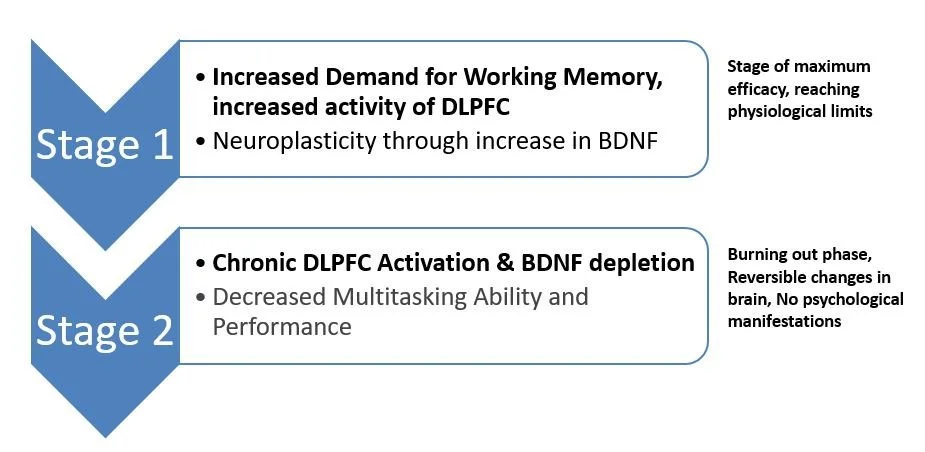
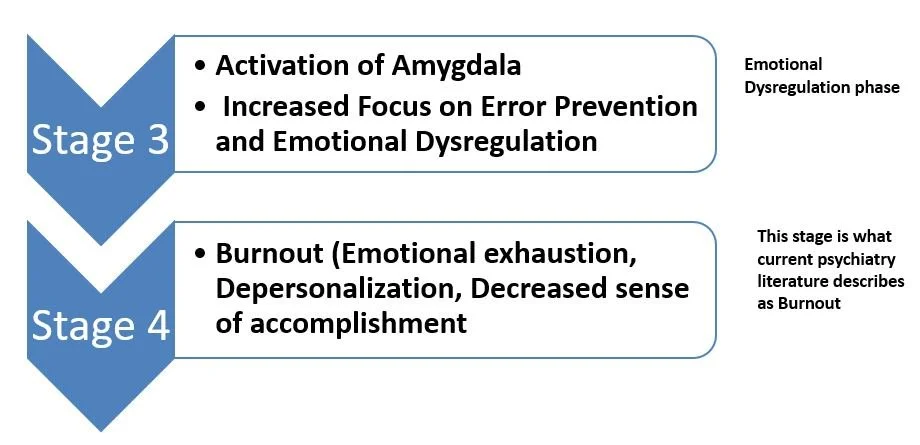
DLPFC - dorsolateral prefrontal cortex
BDNF - Brain derived neurotrophic factor
*Disclaimer: This hypothesis has not yet been tested. Individuals interested in collaborating on the design and execution of studies to evaluate this hypothesis are encouraged to contact us at the email address provided below.
Current understanding of burnout focuses on the effect of stress causing activation of amygdala. cognitive behavioral therapy (CBT) has been shown to be effective in treatment of burnout. But, at least in some individuals, neurological processes (DLPFC dysfunction and reduced volumes, BDNF depletion) precede amygdala hypertrophy and activation. By addressing them, we could prevent and treat burnout in those individuals.