
New research highlights the widespread burden of burnout among academic neurologists and the need for career-long prevention strategies.
A striking finding: Burnout across academic neurology
A recently published study in Neurology: Clinical Practice, titled “Burnout Factors in Neurology: A Survey Assessing Key Factors Among US Academic Faculty,” offers a sobering perspective on physician well-being in academic neurology. Conducted by the Women in Neurology Collaborative Study (WINCS), the research examined burnout among faculty members at 19 academic neurology departments across the United States.
The investigators administered a standardized survey using the abbreviated Maslach Burnout Inventory between December 2020 and March 2022. Of the 311 faculty members who participated, 306 (98.4%) reported moderate-to-high levels of burnout. The magnitude of this finding is concerning and warrants attention from physicians, department leaders, and healthcare institutions.
Although potential self-selection and nonresponse biases should be considered, the results highlight the importance of understanding the factors contributing to burnout in academic neurology and developing effective strategies to address them.
Seven key findings from the study
1. Burnout was prevalent across career stages
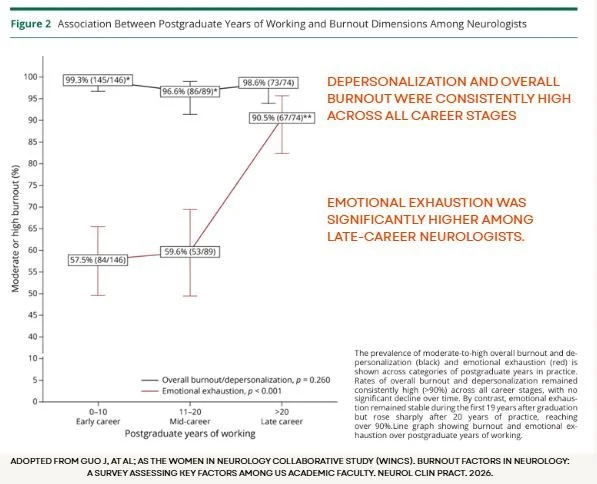
One of the most important findings was that burnout and depersonalization were consistently high across all career stages, exceeding 96.6% in the study population. This challenges the assumption that burnout is primarily a problem for residents, fellows, or early-career faculty.
Academic neurologists may encounter different challenges as their careers progress, but professional experience alone does not necessarily protect against burnout. The cumulative demands of clinical care, teaching, research, administration, and leadership may continue to affect physicians throughout their careers.
2. Emotional exhaustion increased in late-career faculty
Although burnout and depersonalization were prevalent across career stages, emotional exhaustion increased significantly among late-career faculty members (p < 0.001).
Emotional exhaustion is characterized by feeling depleted of emotional and physical energy. For physicians, this may manifest as persistent fatigue, reduced capacity to recover between workdays, and difficulty sustaining the energy required for demanding clinical and academic responsibilities.
This finding suggests that wellness initiatives should not be limited to early-career physicians. Institutions should also consider the evolving needs of experienced faculty members, including those who have spent decades balancing clinical responsibilities with teaching, research, and administrative work.
3. Leadership and research responsibilities were associated with emotional exhaustion
The study found higher observed rates of emotional exhaustion among faculty members holding leadership positions and those with a history of funded research involvement.
In unadjusted analyses, these associations were statistically significant. However, they were no longer statistically significant after adjustment for career stage and the corresponding career advancement indicator. Therefore, the results do not establish that leadership or research responsibilities independently cause emotional exhaustion.
Nevertheless, the findings raise important questions about how academic responsibilities are distributed and supported. Leadership and research can be professionally rewarding, but they may also add substantial responsibilities to an already demanding clinical workload. Institutions should consider whether faculty members have sufficient protected time, administrative support, and flexibility to manage these competing demands.
4. Academic rank may influence emotional exhaustion in mid-career
Among mid-career faculty, full professors had six times the odds of emotional exhaustion compared with assistant professors (odds ratio 6.00; 95% confidence interval 1.34–26.81).
This finding is notable, but the wide confidence interval indicates considerable uncertainty around the magnitude of the association. It should not be interpreted as evidence that promotion itself causes burnout.
One possible explanation is that senior academic roles bring additional responsibilities, including mentorship, departmental leadership, committee work, and institutional service. These demands may accumulate alongside established clinical and research commitments.
Further research is needed to determine which aspects of career advancement are most closely associated with emotional exhaustion and which institutional changes might mitigate these pressures.
5. Overall burnout did not differ significantly by demographic or career characteristics
Despite the observed differences in emotional exhaustion, the investigators did not find statistically significant differences in overall burnout by sex, academic rank, career stage, or career advancement indicators.
This distinction is important. Emotional exhaustion is one component of burnout, and a factor associated with one component does not necessarily explain overall burnout.
The findings reinforce the need to look beyond individual demographic characteristics or academic titles when evaluating physician well-being. Burnout is complex, and its contributing factors may vary across individuals, departments, and career stages.
6. The findings highlight the importance of retaining experienced faculty
Burnout has implications beyond an individual's well-being. Persistent exhaustion and disengagement may affect career satisfaction, professional relationships, and physicians' ability to sustain demanding roles.
When faculty members reduce their clinical effort, leave academic medicine, or exit the profession, the consequences can extend to patient access, teaching capacity, research productivity, and the workload of remaining colleagues.
Although this study did not directly measure physician attrition or establish a causal relationship between burnout and departures, its findings provide a compelling reason for academic departments to examine whether their working environments support long-term, sustainable careers.
7. Burnout prevention must extend throughout a physician's career
The authors conclude that academic neurology departments should consider interventions to reduce burnout, with particular attention to late-career faculty members.
A reasonable next step is to combine organizational interventions with practical strategies that help physicians manage the demands of their work. Potential institutional measures include reviewing clinical and administrative workloads, providing adequate staffing and protected time, clarifying role expectations, and offering meaningful opportunities for professional development and recovery.
Individual-level interventions may complement these efforts, but they should not substitute for addressing workplace conditions that contribute to chronic overload.
Beyond awareness: What can we do about burnout?
The study raises an important question: If burnout is prevalent across career stages, what can physicians and healthcare organizations do differently?
I believe the answer requires attention to both the organizational contributors to burnout and the skills individuals use to manage sustained professional demands.
At the organizational level, healthcare leaders should evaluate workload, staffing, administrative burden, schedule flexibility, and the distribution of clinical and academic responsibilities. Physicians should not be expected to compensate indefinitely for systemic inefficiencies through personal sacrifice.
At the individual level, we should also recognize the importance of recovery, healthy routines, and the ability to manage competing demands. Structured approaches to time management, prioritization, sleep, physical activity, nutrition, and screen-time boundaries may help physicians develop more sustainable habits and support overall brain health. Coaching and peer-based learning can provide opportunities to practice these skills and incorporate them into daily life.
My interest in this area stems from the hypothesis that burnout is not exclusively a psychological response to stress. Sustained overwork, inadequate recovery, and disrupted health behaviors may also affect the brain systems involved in attention, emotional regulation, and cognitive performance. This perspective deserves continued scientific investigation, and interventions should be evaluated rigorously rather than assumed to prevent or reverse burnout.
A call to action for academic neurology
The central message of this study is clear: burnout in academic neurology is not simply an early-career problem, and it should not be treated as an individual's responsibility alone.
The exceptionally high proportion of respondents reporting moderate-to-high burnout, together with the increase in emotional exhaustion among late-career faculty, calls for a broader conversation about how academic medical careers are structured and sustained.
We need better evidence about which interventions work, for whom, and under what circumstances. We also need academic institutions to treat physician well-being as an important component of workforce sustainability, not merely an optional wellness initiative.
At Beat the Burnout, our goal is to complement broader efforts through practical, skills-based workshops that help individuals strengthen their ability to manage professional demands and support colleagues experiencing burnout.
Learn more about our workshops at https://burnouttowellness.com/workshops.
Preventing burnout requires more than helping physicians endure demanding environments. It requires creating environments in which physicians can thrive—and equipping them with the skills to sustain their well-being throughout their careers.
Reference: Guo J, et al. “Burnout Factors in Neurology: A Survey Assessing Key Factors Among US Academic Faculty.” Neurology: Clinical Practice. Published online October 7, 2026. Read the original article.
