
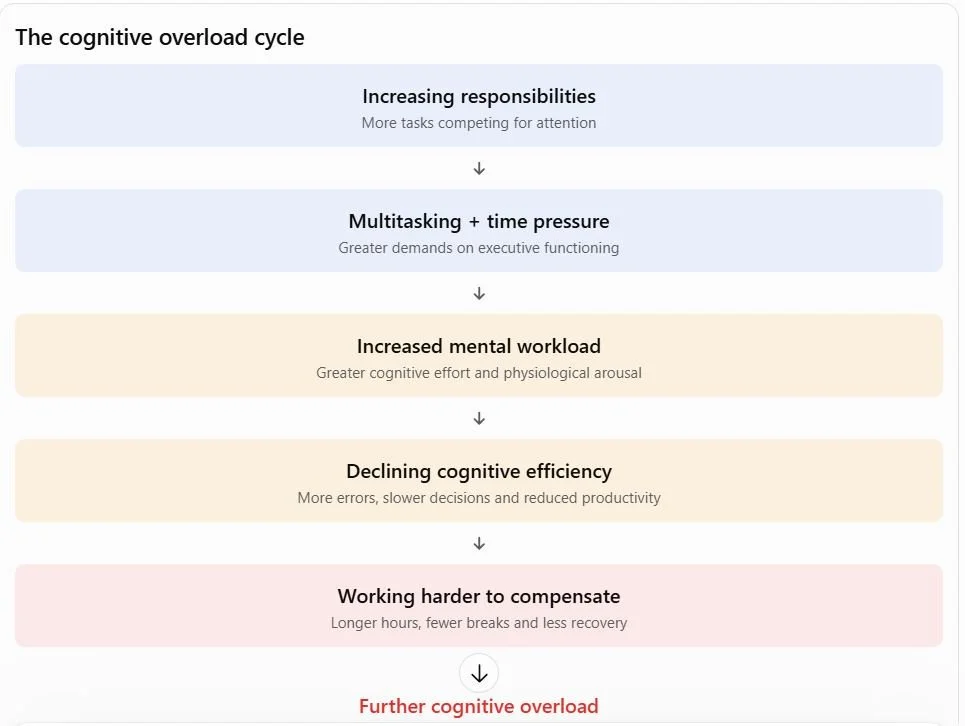
If this cognitive overload cycle persists without adequate recovery, it may contribute to chronic stress, exhaustion, and burnout
We live in a world where multitasking and meeting deadlines are often considered signs of productivity. We juggle competing responsibilities, respond to constant interruptions, and try to accomplish more in less time.
But what happens when multitasking meets time pressure? Our mental workload increases, and our cognitive performance may suffer.
1. What is mental workload?
Mental workload refers to the cognitive effort required to meet the demands of a task. Our brain has limited resources for attention, working memory, decision-making, and problem-solving.
Consider a physician who is evaluating patients, reviewing test results, responding to messages, completing documentation, and managing administrative responsibilities, all within tight deadlines.
Each task requires mental effort. As demands accumulate, they compete for the brain’s limited cognitive resources.
2. The hidden cost of multitasking
Contrary to popular belief, the brain does not efficiently perform multiple complex tasks simultaneously. Instead, it often switches rapidly between tasks.
Each switch requires the brain to redirect attention, retrieve relevant information, and re-establish the context of the new task. Repeated switching consumes cognitive resources, increases the risk of errors, and reduces efficiency.
Even when individual tasks seem manageable, the cumulative cost of switching between them can be substantial.
3. Time pressure makes things worse
When we have insufficient time to complete our responsibilities, the brain must process information and make decisions faster.
This increases demands on attention, working memory, and executive functioning. We may rush decisions, postpone breaks, or carry unfinished tasks forward.
The result is not necessarily greater productivity. Instead, we may expend more effort while becoming less efficient.
4. What happens inside the brain?
The prefrontal cortex, particularly the dorsolateral prefrontal cortex, plays a critical role in attention, working memory, planning, and decision-making.
When multitasking and time pressure increase, these brain regions face greater demands.
A 2022 study published in Brain and Behavior examined mental workload during simulated flight tasks. Researchers found that higher workload was associated with increased prefrontal cortex activation, higher heart rates, and poorer performance on certain tasks.
These findings suggest that increased mental workload has measurable brain and physiological correlates. Greater brain activation does not necessarily mean better performance; it may reflect the additional effort required to cope with increasing demands.
5. When mental workload becomes excessive
The brain can compensate for increasing demands, but its capacity is not unlimited.
When cognitive demands exceed available resources, we may experience difficulty concentrating, forgetfulness, slower decision-making, reduced productivity, and increased errors.
We may try to compensate by working longer hours and putting in additional effort, sacrificing breaks and recovery in the process.
If this pattern persists, it can contribute to chronic stress, exhaustion, and vulnerability to burnout. Although mental workload and burnout are not the same, prolonged excessive demands can be an important part of the problem.
6. How can we reduce mental workload?
We cannot always eliminate competing responsibilities, but we can change how we manage them.
Reduce unnecessary multitasking: Focus on one demanding task at a time whenever possible.
Prioritize effectively: Identify what needs immediate attention and what can be delegated or postponed.
Manage time pressure: Set realistic deadlines and allow adequate time for complex tasks.
Take regular breaks: Give your brain opportunities to recover between demanding activities.
Protect brain health: Prioritize sleep, physical activity, and balanced nutrition.
Address workplace demands: Excessive workloads, inadequate staffing, frequent interruptions, and administrative burden require organizational solutions—not simply greater individual resilience.
Reference: Li W, Li R, Xie X, Chang Y. Evaluating mental workload during multitasking in simulated flight. Brain Behav. 2022 Apr;12(4):e2489. doi: 10.1002/brb3.2489. Epub 2022 Mar 15. PMID: 35290712; PMCID: PMC9014989. https://pmc.ncbi.nlm.nih.gov/articles/PMC9014989/
The takeaway
Multitasking + time pressure = increased mental workload.
Being busy is not the same as being productive. When we continually push our brains to manage competing demands under tight deadlines, we risk sacrificing efficiency, performance, and well-being.
Sustainable productivity requires more than working harder. It requires understanding how our brains function and developing practical skills to manage cognitive demands effectively.
Ready to enhance your skills and support your brain health?
Attend our Beat the Burnout skills workshops to develop practical strategies for managing workplace demands, supporting colleagues, and building healthier habits.
Explore our workshops: www.burnouttowellness.com/workshops
