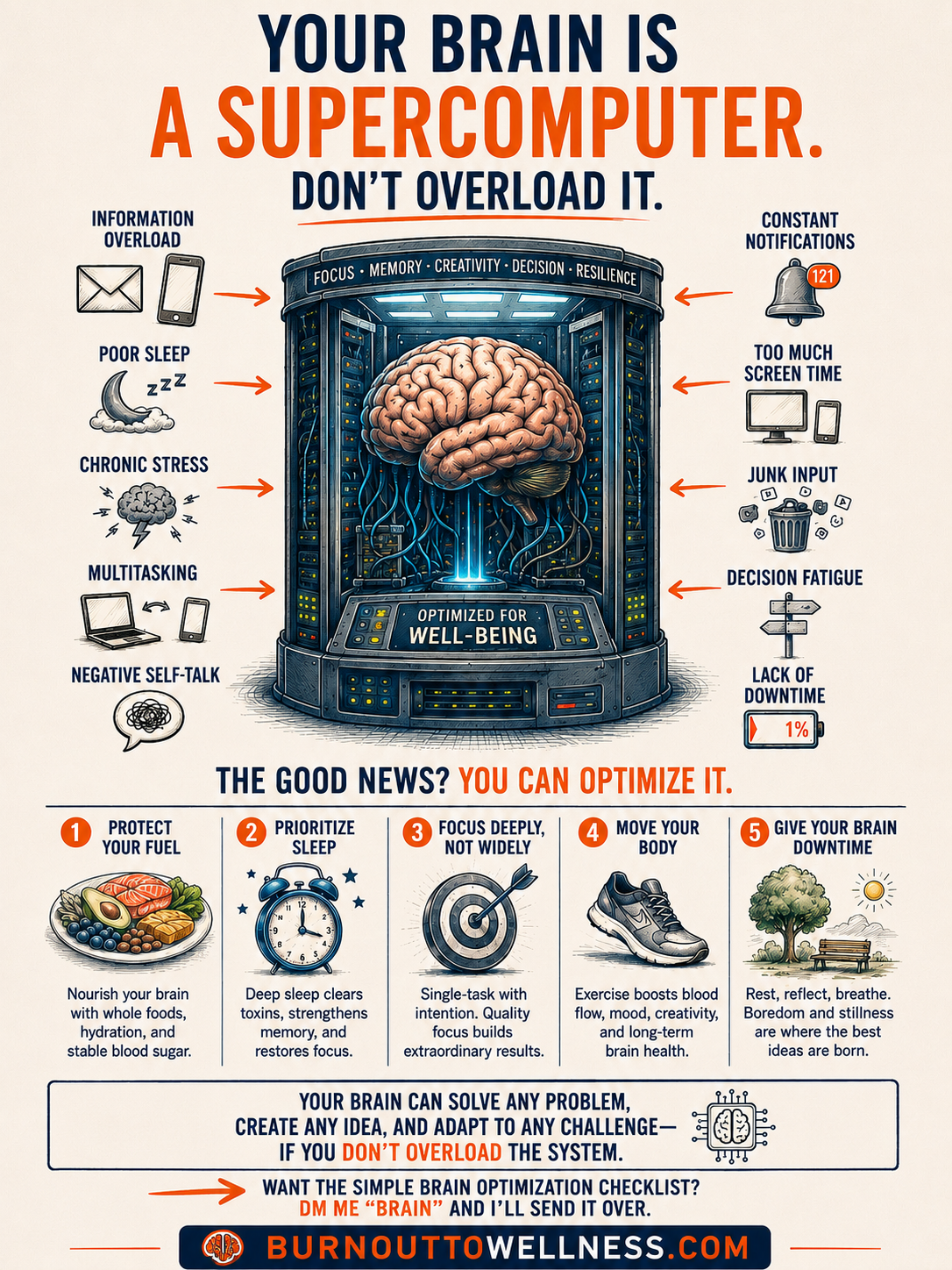
Your Brain Is a Supercomputer: Don’t Overload It
The human brain can learn complex skills, create original ideas, solve unfamiliar problems, and adapt to changing circumstances. However, like any high-performing system, it works best when its resources are protected.
Modern life places the brain under a nearly continuous stream of demands. Emails arrive while we are completing other tasks. Notifications interrupt conversations. Work follows us home through our phones, and even rest can become filled with news, entertainment, and social media.
This constant input may feel productive, but the brain does not have unlimited processing capacity. Information overload, poor sleep, chronic stress, multitasking, excessive screen time, and a lack of genuine downtime can gradually reduce focus, memory, creativity, and emotional resilience.
Optimizing the brain does not require doing more. In many cases, it begins with creating the conditions that allow the brain to work effectively.
What does brain overload actually mean?
“Brain overload” is not a formal medical diagnosis. It is a useful way to describe what happens when the demands placed on our attention and working memory begin to exceed the resources available.
Working memory is the brain’s temporary mental workspace. It allows us to hold and use small amounts of information while reading, solving a problem, making a decision, or following a conversation. Because this workspace is limited, performance may decline when too many competing demands are introduced at once.
A person experiencing cognitive overload may have difficulty concentrating, remembering details, organizing thoughts, or making decisions. Familiar tasks may take longer, and small problems may feel unusually frustrating.
These difficulties do not necessarily mean that something is permanently wrong with the brain. They may instead be signs that the brain is being asked to process too much without adequate recovery.
Information overload and constant notifications
Access to information can be valuable, but more information is not always better. The brain must evaluate each new message, headline, alert, and request to determine whether it is relevant.
Even briefly checking a notification can disrupt concentration. After an interruption, the brain must remember what it was doing, reconstruct the original thought process, and redirect attention to the task. When this happens repeatedly, a significant amount of mental energy is spent switching rather than progressing.
Notifications can also create a sense that everything requires an immediate response. This keeps the brain in a reactive state, constantly waiting for the next demand.
Reducing unnecessary alerts, scheduling specific times to check messages, and creating periods of uninterrupted work can protect attention. The goal is not to eliminate technology but to prevent every piece of information from receiving equal access to the brain.
Why multitasking is mentally expensive
Multitasking is often treated as an essential professional skill. However, when two activities both require conscious attention, the brain usually does not perform them simultaneously. Instead, it switches rapidly between them.
Each switch has a cognitive cost. The brain must pause one set of instructions, activate another, and later reconstruct where it left off. Frequent switching may increase errors, slow progress, and make tasks feel more exhausting.
This is especially important during work that requires careful judgment, learning, writing, or problem-solving. Dividing attention between a complex task and a conversation, message thread, or second screen can interfere with both activities.
Single-tasking does not mean ignoring every responsibility except one for an entire day. It means giving one important task full attention for a protected period before intentionally moving to the next.
Quality focus often produces better results than scattered activity.
Sleep restores the brain’s capacity
Sleep is one of the most important forms of neurological recovery. During sleep, the brain processes memories, regulates emotions, and supports physical and cognitive restoration.
When sleep is inadequate, attention becomes harder to sustain. Working memory, reaction time, decision-making, and emotional control may also decline. This leaves the brain with fewer resources to manage the same amount of information.
Poor sleep can also intensify other sources of overload. Notifications feel more irritating, decisions require more effort, and ordinary setbacks may trigger stronger emotional reactions.
For busy professionals, shortening sleep may appear to create extra productive time. However, the hours gained at night can be offset by slower thinking, reduced accuracy, and lower efficiency the following day.
Protecting sleep is therefore not separate from productivity. It is part of the system that makes reliable performance possible.
Chronic stress keeps the system activated
The brain and body are designed to respond to short-term threats. Stress hormones increase alertness and prepare us to act. This response can be helpful during an emergency or a temporary challenge.
Problems arise when the stress response rarely has an opportunity to deactivate.
Chronic stress can keep the mind scanning for problems even when no immediate danger is present. It may become harder to relax, sleep, concentrate, or think creatively. Over time, a person may feel constantly busy while accomplishing less than expected.
Stress can also narrow attention. When the brain is focused on immediate threats and unfinished responsibilities, fewer mental resources remain available for reflection, long-term planning, and flexible problem-solving.
Stress management should not be used to excuse excessive workloads or unhealthy environments. Organizations share responsibility for addressing unreasonable demands, inadequate staffing, and workplace cultures that prevent recovery.
Still, individual recovery practices can help the nervous system move out of a constant state of activation.
Too much screen time and low-value input
Screens are not automatically harmful. They allow us to work, learn, communicate, and access important services. The concern is how screens are used and what they may displace.
Frequent exposure to rapidly changing content trains attention to expect continual novelty. A person may become uncomfortable with slower activities that require sustained concentration, such as reading, planning, or listening carefully.
Late-night screen use may also interfere with sleep when it delays bedtime, increases mental stimulation, or exposes a person to emotionally activating content.
Not all input deserves equal space in the mind. Low-value content, repeated checking, and endless scrolling can consume attention without providing meaningful rest or knowledge.
Intentional screen use begins with asking a simple question: Is this activity helping me complete something important, connect with someone, or genuinely recover?
Decision fatigue drains mental energy
Every decision requires some level of cognitive effort. Most individual choices are small, but their effects can accumulate throughout the day.
Responding to messages, choosing what to prioritize, changing between tasks, resolving minor problems, and deciding what to ignore can gradually make later decisions feel more difficult. This experience is often described as decision fatigue.
When mentally tired, people may delay decisions, make impulsive choices, or rely on the easiest available option. They may also become less patient when unexpected decisions appear.
Simple routines can reduce unnecessary cognitive demand. Preparing meals in advance, using a consistent morning routine, establishing default work processes, and identifying the day’s main priorities can preserve decision-making capacity for matters that require genuine judgment.
The goal is not to remove choice from life. It is to stop spending valuable mental energy repeatedly solving the same minor problems.
Negative self-talk adds another layer of demand
External information is not the only source of overload. Internal commentary can consume attention as well.
Thoughts such as “I should be doing more,” “I am falling behind,” or “I cannot handle this” can run in the background while a person is trying to work or rest. These thoughts may increase stress and make challenges feel less manageable.
Healthy self-talk does not require pretending that everything is easy or positive. It involves describing situations accurately and responding constructively.
Instead of saying, “I am failing at everything,” a person might recognize, “I am overloaded, and I need to identify the next manageable step.” This shift does not eliminate the problem, but it gives the brain a clearer direction.
Self-compassion can also support resilience. Speaking to ourselves with the same fairness we would offer a colleague or friend may reduce unnecessary emotional strain and make it easier to recover from mistakes.
Protect the brain’s fuel
The brain depends on a steady supply of energy and nutrients. Regular meals, adequate hydration, and a varied diet support the biological processes required for concentration and overall health.
There is no single food that can transform memory or prevent every neurological condition. Brain health is better supported by consistent dietary patterns than by isolated “superfoods” or supplements.
Meals that include vegetables, fruit, whole grains, healthy fats, and sources of protein can help support stable energy. Hydration is also important because even mild dehydration may contribute to fatigue, headaches, or difficulty concentrating in some people.
Caffeine can temporarily increase alertness, but it cannot replace sleep. Excessive or late-day caffeine may also interfere with the recovery the brain needs most.
Nutrition should be viewed as one component of brain health alongside sleep, movement, stress management, cardiovascular health, and appropriate medical care.
Move the body to support the brain
Physical activity benefits more than muscles and cardiovascular fitness. Movement supports blood flow, mood, sleep quality, and many processes connected to long-term cognitive health.
Exercise can also provide a valuable break from continuous mental work. A walk, brief mobility session, or workout creates a change in environment and allows attention to disengage from the same stream of demands.
The most helpful form of movement is usually one that can be performed consistently. It does not need to be extreme. Walking, swimming, cycling, dancing, strength training, and recreational sports can all contribute to health.
Short movement breaks during the workday may also reduce physical tension and help restore attention, particularly for people who spend long periods sitting or working at screens.
Downtime is productive maintenance
Many people feel guilty when they are not actively completing a task. However, the brain needs periods in which it is not reacting to demands.
Quiet walks, time outdoors, unstructured reflection, breathing exercises, and other low-stimulation activities can give the mind space to process experiences and connect ideas.
Boredom can also have value. When external stimulation decreases, the brain has an opportunity to wander, reflect, and generate associations that may not appear during tightly controlled work.
This is one reason ideas often arise in the shower, during a walk, or shortly before sleep. Creativity does not always occur when we force the brain to produce. It can emerge when we temporarily stop filling every available moment.
Downtime should not be confused with endless digital consumption. An hour of rapid scrolling may keep the brain stimulated even if no formal work is being completed. Genuine recovery usually requires some separation from incoming demands.
Practical ways to reduce brain overload
Brain optimization does not require a complicated routine. Small changes that reduce unnecessary input and improve recovery can make daily life more manageable.
Helpful strategies may include:
Turning off nonessential notifications
Identifying one to three priorities for the day
Working on one cognitively demanding task at a time
Scheduling specific periods for email and messages
Taking short movement breaks between focused work sessions
Keeping sleep and wake times reasonably consistent
Creating screen-free periods, especially before bed
Using routines to reduce repetitive decisions
Eating regularly and staying adequately hydrated
Spending time outdoors or in low-stimulation environments
Writing down unfinished tasks instead of mentally rehearsing them
Seeking professional support when stress, sleep problems, anxiety, or cognitive changes persist
The most effective approach will vary depending on a person’s responsibilities, health, schedule, and environment. The purpose is not to follow every strategy perfectly. It is to remove enough unnecessary strain that the brain can direct its resources toward what matters most.
How does this relate to burnout?
Brain overload and occupational burnout frequently reinforce each other.
Chronic workplace stress can reduce sleep, increase emotional exhaustion, and make it difficult to mentally disconnect after work. As cognitive resources decline, ordinary responsibilities require more effort. This may lead people to work longer hours, skip breaks, and remain constantly connected in an attempt to keep up.
The result can become a cycle: high demands reduce recovery, and inadequate recovery makes those demands increasingly difficult to manage.
Personal strategies such as sleep, exercise, focused work, and downtime can support resilience, but they cannot repair a harmful workplace by themselves. Burnout prevention also requires realistic workloads, adequate staffing, supportive leadership, psychological safety, and genuine opportunities for recovery.
A healthy organization does not depend on employees repeatedly pushing their brains beyond sustainable limits.
Optimize the system—don’t overwhelm it
The brain is capable of extraordinary work, but its capacity is not infinite. Focus, memory, creativity, judgment, and resilience depend on how well we protect the systems that support them.
Constant stimulation is not the same as meaningful productivity. Multitasking is not always efficiency, and rest is not wasted time.
Protecting the brain means giving it appropriate fuel, sufficient sleep, regular movement, focused work, and periods of genuine downtime. It also means setting boundaries around the information and demands allowed to compete for attention.
Your brain can solve complex problems, create new ideas, and adapt to difficult circumstances. But even the most powerful system performs better when it is maintained, protected, and given time to recover.